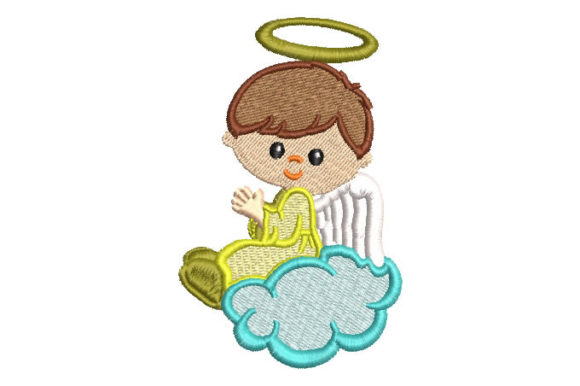
Angel Child Praying Embroidery Design Review
First Impression: Gentle, Timeless, and Brand-Ready
As an embroidery designer who’s developed hundreds of commercial designs for small businesses—from boutique florists to handmade baby brands—I immediately recognize Angel Child Praying as a design with quiet confidence. It doesn’t shout; it invites. The title alone signals warmth, reverence, and soft sophistication—ideal for businesses rooted in care, nurturing, or gentle craftsmanship. While categorized under Babies, its visual language extends far beyond infant apparel: think café aprons with embroidered lapel accents, floral shop tote bags, pet boutique gift tags, or even artisanal bakery packaging seals. It reads as classic—not dated—and elegant—not fussy. That balance is rare, and valuable.
Real-World Business Use: Where Angel Child Praying Shines
Angel Child Praying performs exceptionally well across high-visibility small business merch. As an embroidered patch, it holds up beautifully on denim jackets, canvas totes, and staff uniforms—especially when stitched with matte cotton or rayon thread for subtle texture. On aprons for bakeries or craft studios, it adds a hand-finished touch without overwhelming the garment’s function. For cap embroidery, position it cleanly on the front panel (not the curve) and use a medium-density stitch count—this avoids puckering while preserving delicate contour lines in the child’s pose and wings.
For tote bag design, scale it slightly larger (3.5–4 inches wide) to anchor the side seam or bottom corner. Its balanced proportions prevent visual drift, and its centered composition makes it ideal for printable mockups you’ll share with clients before production. In custom apparel for local studios or Etsy sellers, Angel Child Praying reinforces brand identity by evoking sincerity and intention—qualities that build customer trust faster than slogans ever could.
It also works thoughtfully on product packaging: embroidered onto muslin gift bags, linen labels for handmade soaps, or even as a small chest accent on organic cotton onesies. Because it carries emotional resonance—not trend-driven novelty—it supports long-term recognition, especially for businesses building legacy rather than chasing viral moments.
Careful Application: Know the Limits Before You Stitch
Like any refined machine embroidery design, Angel Child Praying demands thoughtful placement. Avoid shrinking it below 2.25 inches wide for patches—fine details like fingers, wing feathers, or facial contours may blur or vanish entirely. Cap fronts with tight curvature require testing: the design’s gentle curves translate well, but avoid stretching it over peak seams where distortion occurs.
On dark uniforms or textured fabric (like heavy twill or bouclé), confirm thread color contrast—light ecru or pearl white often reads cleaner than stark white. High stitch density can cause stiffness in lightweight fabrics, so pair it with cutaway stabilizer for structured items (e.g., work shirts) and tear-away for softer applications (e.g., baby blankets). And always test-wash a sample: repeated laundering reveals how well the design holds detail and whether thread migration occurs near fine outlines.
Brand Identity & Customer Connection: More Than Just a Motif
When customers see Angel Child Praying on your apron, tote, or staff cap, they’re not just seeing decoration—they’re sensing your values. It subtly communicates compassion, attention to detail, and reverence for life’s quiet moments. That subtext strengthens brand identity for creative studios, holistic wellness shops, faith-aligned boutiques, and family-run businesses alike.
Unlike generic icons or overused script logos, this design stands out in crowded markets precisely because it feels intentional—not algorithmic. It elevates perceived product value: a $28 linen tote with Angel Child Praying embroidered in tonal thread reads as heirloom-quality, not disposable. For Etsy sellers and handmade brands, that distinction directly impacts buyer engagement, repeat orders, and word-of-mouth referrals.
Practical Designer Notes for Commercial Embroidery Success
- Test in black and white first—verify clarity of silhouette and spacing before committing to full thread palette.
- Check small patch viability: resize to 2.5” and stitch on scrap fabric matching your final substrate.
- Review thread color contrast on both light and dark backgrounds—especially if branding uses dual-tone uniforms.
- Inspect spacing between elements: ensure wing tips, hands, and hemline maintain breathing room at target size.
- Confirm hoop size compatibility—some versions may require 5x7” or larger; verify before digitizing adjustments.
- Test on real fabric, not just stabilizer—fabric texture dramatically affects stitch definition.
- Use appropriate stabilizer: cutaway for stretch knits or heavy wear, tear-away for stable wovens.
- Create a client-ready mockup using the digital embroidery file—visual alignment builds confidence before production.
- Compare beside other design assets: does Angel Child Praying harmonize with your logo, typography, and color system?
- Confirm commercial licensing before applying to merchandise—you need explicit rights for resale, especially for small business merch and custom apparel.
Remember: the strength of Angel Child Praying lies not in complexity, but in considered restraint. Its simplicity allows it to adapt—across age groups, industries, and materials—without losing meaning. Whether you’re stitching for a newborn boutique or a community garden co-op, this embroidery file delivers quiet professionalism, emotional resonance, and lasting visual consistency. Just treat it with the same care your customers give to your finished product.